
- calendar_today August 16, 2025
.
NASA’s James Webb Space Telescope (JWST) has spotted a small, previously unseen moon around Uranus, one of the nine planets in the solar system. The ice giant already has 28 known moons, and scientists expect there are more.
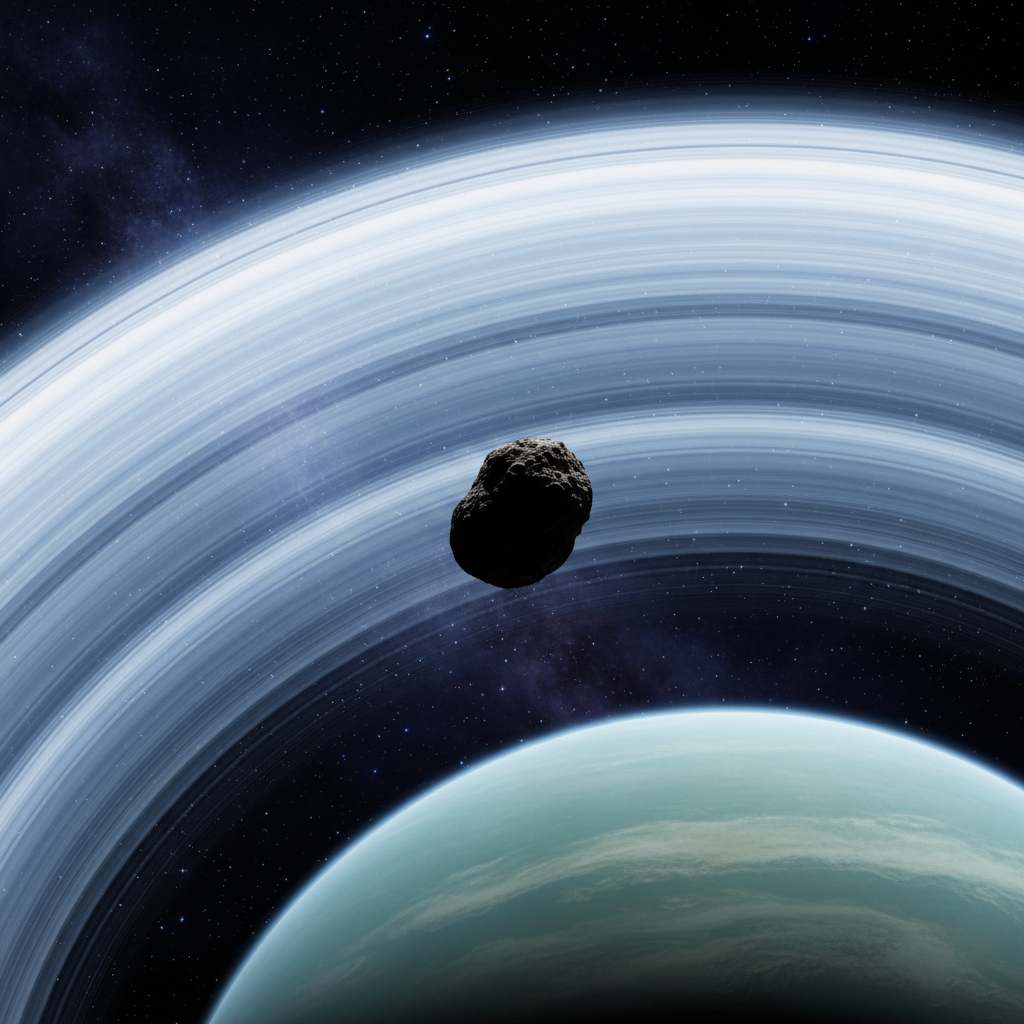
On February 2, a faint object was seen in a set of long-exposure images of Uranus, each taken by Webb over a period of 40 minutes using its Near-Infrared Camera. The new moon is only about 6 miles (10 kilometers) across, one of the smallest natural satellites found orbiting Uranus to date. It is so dark, small, and quick-moving that it was hidden from previous spacecraft and telescopes by Uranus’s much brighter rings. The planet’s rings and proximity to the host planet likely masked the object, including from Voyager 2, NASA’s lone spacecraft to fly past Uranus nearly 40 years ago.
“This is a small moon but a big discovery,” said lead scientist Maryame El Moutamid of the Southwest Research Institute’s Solar System Science and Exploration Division in Boulder, Colorado. El Moutamid is also the principal investigator (PI) of one of the Webb programs dedicated to the study of Uranus’ rings and inner moons. “The team is excited that even after decades of space and ground-based exploration, Webb is revolutionizing our understanding of Uranus’ moons and rings,” she added.
The discovery is a testament to Webb’s infrared sensitivity. “The new moon’s small size, rapid motion, and dark color have made it challenging for astronomers to tease apart from Uranus’ bright glare and rings,” said El Moutamid. Webb has a unique set of sensitive infrared detectors to capture light too faint for visible-light telescopes like Hubble to see. The space telescope’s observations of Uranus already hinted at secrets about the planet’s rings, weather, and atmosphere.
“A Tiny World Gets Bigger in Uranus’ Ring System”
The new moon, nicknamed S/2025 U1, orbits about 35,000 miles (56,000 kilometers) from Uranus’ center. The object traces a nearly circular path that lies in Uranus’ equatorial plane, or the imaginary flat plane that extends out from the planet’s equator into space. It circles Uranus between the previously known moons Ophelia (just outside Uranus’ main ring system) and Bianca. Its position in this so-called Uranian Satellites System 3 (USS3) ring group could mean the moon formed near its current location.
The find is the 14th small moon to join Uranus’ system of five major moons (Miranda, Ariel, Umbriel, Titania, and Oberon) and a collection of smaller satellites. Scientists have no idea why Uranus has so many small moons so tightly packed in the innermost region of its system. The small inner moons are packed so tightly that the gravitational pull from their orbital overlap should destabilize the system. For some reason, it does not. One possibility is that these moons shepherd Uranus’ narrow rings like cosmic barstools at a popular establishment.
The outer moons are thought to be asteroids captured by Uranus’ gravity. In contrast, the inner moons are rock and ice, as suggested by how they reflect sunlight. Unlike most objects in the solar system that orbit in a clockwise direction, Uranus rotates and orbits counterclockwise, or “retrograde.” Some of Uranus’ moons also move in the opposite direction, or “anti-retrograde,” indicating they could be fragments of captured bodies.
The discovery of the 29th known Uranian moon marks a new frontier in the study of the solar system’s seventh planet. According to El Moutamid, the new moon “raises questions about how many more small moons remain undiscovered around Uranus and how they might be interacting with the planet’s rings.”
Astronomer Scott Sheppard at the Carnegie Institution for Science in Washington, D.C., and co-discoverer of a Uranus moon in 2024, was not involved in the new study. But he called the latest discovery “very exciting.” “It’s quite remarkable to find such a tiny object,” he said, adding that this particular object is “very close to Uranus’ inner ring system and seems to be associated with it.” In other words, it is a part of Uranus, Sheppard explained.
“This remarkable discovery by Webb illustrates the very blurry line between Uranus’ moons and rings,” said Matthew Tiscareno, SETI Institute co-principal investigator in the Webb Uranus project, and the program’s outreach and education specialist. “Their complex inter-relationships hint at a chaotic history,” Tiscareno added.
Two astronomers with Voyager 2 credit the spacecraft with the most significant discoveries of Uranus’ moons: its largest, five, known to Earth as early as 1787, and 10 more ranging in diameter from 16 to 96 miles (26 to 154 kilometers). Later observations with large ground-based telescopes and the Hubble Space Telescope added another 13 small moons, each 8 to 10 miles (12 to 16 kilometers) in diameter and “blacker than asphalt.” On the inner moons, these satellites may be composed of ice and rock. Uranus’ outer moons, beyond Oberon, the fifth of the large satellites, are thought to be captured asteroids.
NASA’s next large planetary mission is a Uranus Orbiter and Probe mission, recommended by a planetary decadal survey published by the National Academies of Sciences, Engineering, and Medicine in 2022. But the money is not guaranteed as Congress and the White House wrangle over budgets. It could launch as early as the 2030s, but 2024 will not be it. If selected, the mission would launch a pair of spacecraft, one to orbit Uranus and one to plunge through its atmosphere. The spacecraft would gather information about the planet’s tilted axis of rotation, its complex magnetic field, its atmospheric dynamics, and even its moons and any icy ocean worlds that may lurk there.