
- calendar_today August 20, 2025
On Thursday, researchers at Carnegie Mellon University unveiled a groundbreaking innovation: LegoGPT represents a new artificial intelligence model that converts basic text instructions into stable Lego constructions. The newly developed system creates Lego designs based on textual descriptions and makes certain that these designs can be assembled brick by brick in real life through human or robotic construction.
The team presented their method in a research paper called “Generating Physically Stable and Buildable Lego Designs from Text,” which they shared on arXiv. Their method involves building a large dataset of physically stable LEGO designs with captions and training an autoregressive language model to anticipate next-brick placement using next-token prediction.
The model trained with precision enables the creation of LEGO designs from different textual prompts like “a streamlined, elongated vessel” or “a classic-style car with a prominent front grille.” The designs produced at this stage show simplicity because of their limited brick types while forming basic shapes, but their main success stems from their inherent stability.
Addressing the Limitations of Existing 3D Generation
Ava Pun’s research group identified a major obstacle within 3D generation technology. The current models produce complex geometric designs with diversity but encounter difficulties during physical construction. Researchers pointed out that design components will collapse, float, or stay unconnected in the absence of proper support.
LegoGPT sets itself apart from earlier autonomous Lego modeling projects because it creates sequential building instructions for Lego creations that will maintain their stability. The project’s website provides demonstrations that exhibit the system’s impressive functionalities.
How LegoGPT Works: From Language Model to Brick Placement
LegoGPT uses advanced technology from large language models like ChatGPT to create its innovative approach. The LegoGPT system replaces the traditional next-word prediction method with a next-brick prediction approach. The Carnegie Mellon team implemented fine-tuning on LLaMA-3.2-1B-Instruct which is an instruction-following language model created by Meta to achieve their intended outcome.
The team added a separate software tool to the brick-predicting model which checks for physical stability. A mathematical modeling tool simulates structural forces and gravity effects on new Lego design structures.
LegoGPT’s training set consisted of a newly created dataset named “StableText2Lego,” which included over 47,000 stable Lego structures with descriptive captions produced by OpenAI’s sophisticated GPT-4o AI model. The dataset includes every structure that has been subjected to thorough physics analysis for real-world building feasibility.
The LegoGPT system functions by producing accurate sequences for brick placement. The system verifies that every new brick placement avoids existing brick collisions and stays within the specified building area. The previously mentioned mathematical models are over to confirm that a finished design maintains its structural integrity once completed.
The “physics-aware rollback” method stands as a key factor behind LegoGPT’s success. The system detects design instability by identifying the first unstable brick and then removing it along with all following bricks before exploring a different design strategy. The research team discovered the method necessary because it increased stable LegoGPT designs from 24 percent to 98.8 percent.
Real-World Validation: Robots and Human Builders
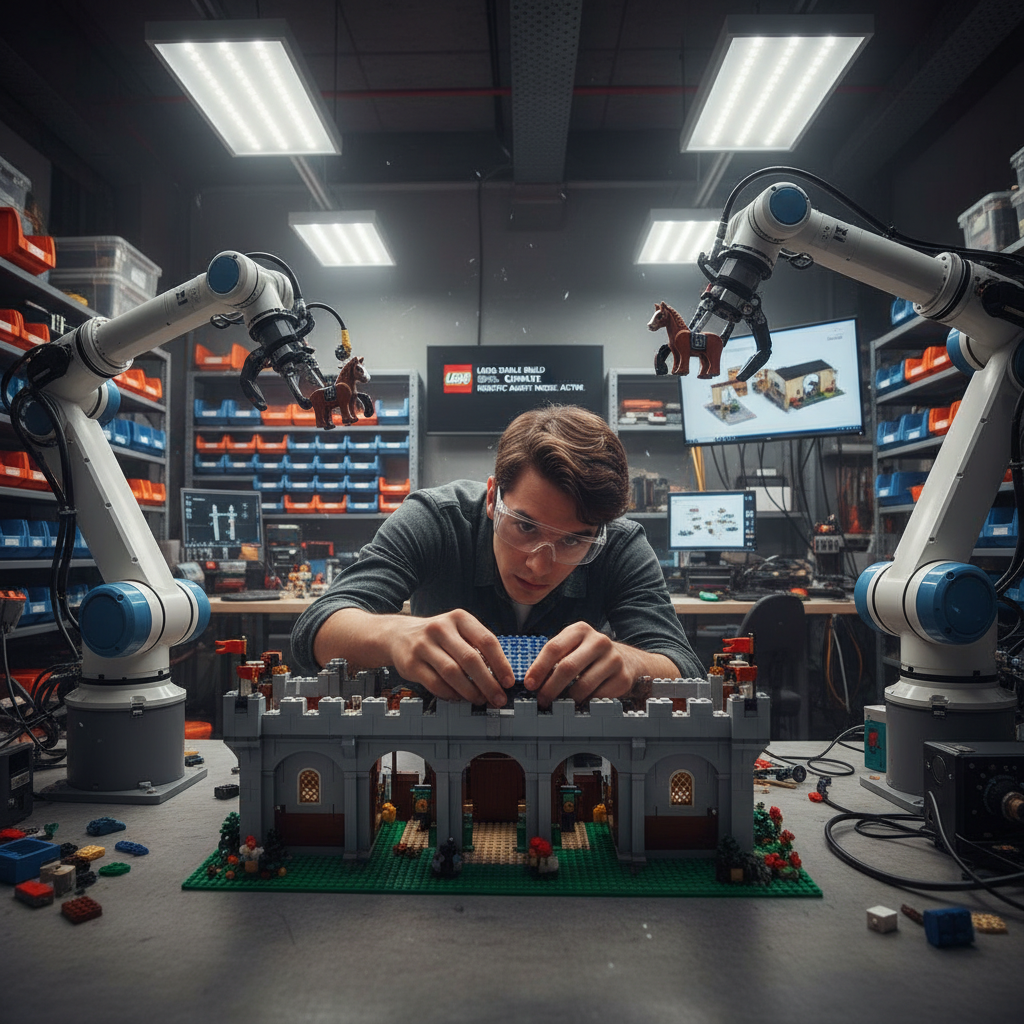
To evaluate the practicality of designs generated by their AI system the researchers performed assembly experiments in real-world settings. The researchers used a two-robot arm setup with force sensors to accurately follow LegoGPT instructions for brick placement.
Human testers built select AI-created models by hand demonstrating that LegoGPT generates structures which are truly buildable. According to the team’s paper their experiments confirmed that LegoGPT generates stable Lego designs which both match the input text prompts and maintain visual appeal.
LegoGPT demonstrated superior performance compared to other 3D creation AI systems, such as LLaMA-Mesh, because of its consistent commitment to structural integrity, which led to the highest stability percentage among generated structures.
Looking Ahead: Expanding the Lego Universe
The existing version of LegoGPT demonstrates notable accomplishments but still faces operational restrictions. The version of LegoGPT under discussion functions within a set space measuring 20 bricks by 20 bricks by 20 bricks while only integrating eight standard brick types. The team admitted that their method is compatible only with a predetermined group of standard Lego bricks. Our future work will focus on increasing the diversity of our brick library by adding bricks with different dimensions and types like slopes and tiles.
LegoGPT serves as a major advancement that bridges artificial intelligence with physical construction capabilities. The emphasis on stability and buildability allows the development of future AI systems that can turn digital designs into real-world applications, opening opportunities for industries such as robotics and manufacturing, as well as the enjoyment of Lego building.