
- calendar_today August 14, 2025
.
Electric vehicle (EV) adoption in the United States faces new headwinds, with slowing sales and infrastructure concerns emerging. After 15 straight months of month-over-month EV sales growth, the market contracted in June. From Genesis to Volvo, premium automakers have watched customers turn away from their electric models and have been forced to reassess their EV strategies.
Yet with the Biden administration cutting subsidies and loosening vehicle pollution standards, less is known about what might be deterring buyers on the federal level. But the biggest headwind could already be in consumers’ garages, according to market analysts.
Parking Spaces for Plugs
The lack of charging infrastructure has long been a common refrain from prospective EV drivers. In fact, surveys have repeatedly found that charging concerns are the biggest deterrent to buying electric. But a new report from Telemetry Vice President Sam Abuelsamid highlights a rarely discussed issue that sits at the heart of the charging problem: parking habits.
Home charging remains the foundation of the EV ecosystem, despite much of the media attention on fast-charging infrastructure. In the United States, a growing share of all EV charging is done at home, with an estimated 80 percent of all EV charging performed with AC power at a single-family residence.
National Renewable Energy Laboratory (NREL) researchers found that 42 percent of U.S. homes already have access to a charging-ready outlet that can accommodate a level 2 (240-volt) charger, if the vehicle is parked close to it.
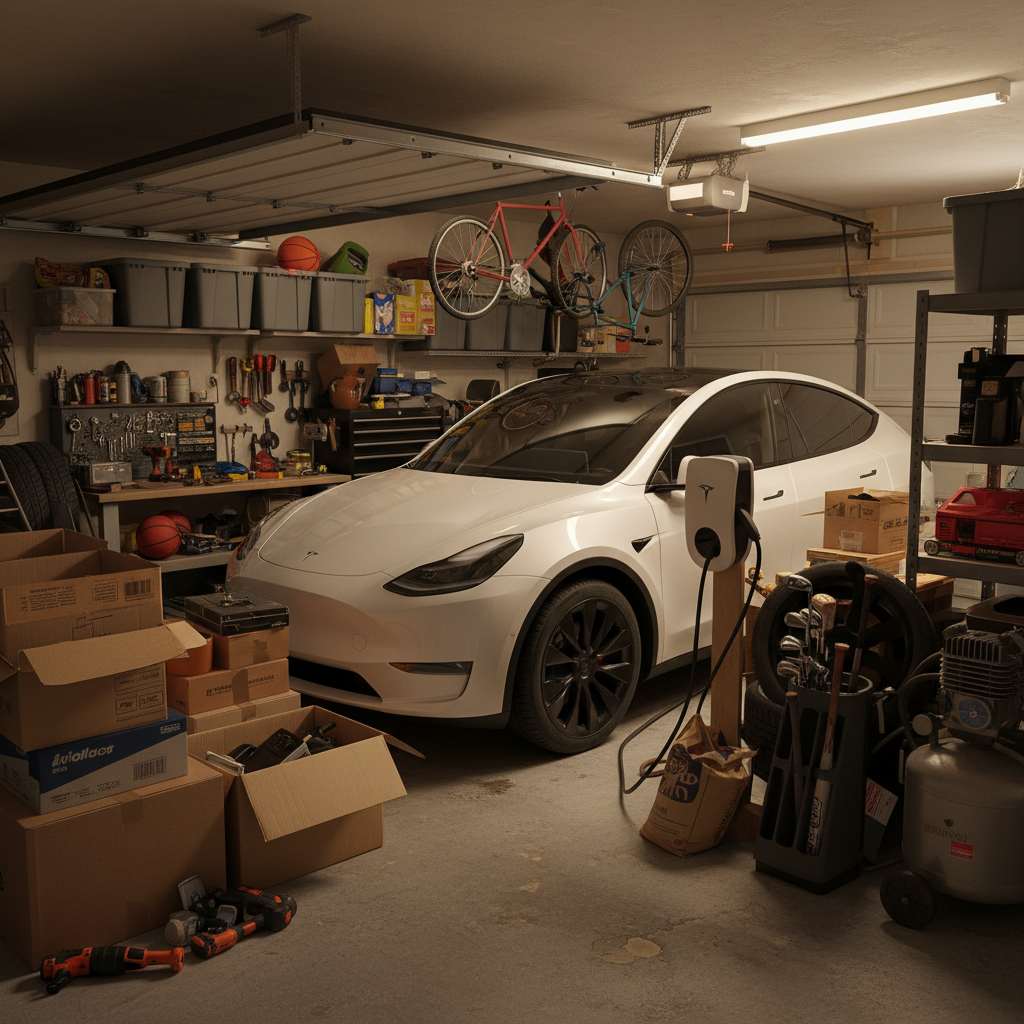
That proportion would increase to 68 percent if homeowners made their garages and driveways available to vehicles instead of using them for storage, says Abuelsamid. “90 percent of all houses can add a 240 V outlet near where cars could be parked. Parking behavior, namely whether homeowners use a private garage for parking or storage, will likely become a key factor in EV adoption.”
Factoring in both existing garages plus homes where wiring is technically possible, about 72 million of 131 million U.S. homes would be able to support an EV with a level 2 charger. This figure would even top Telemetry’s own 2035 high estimate for U.S. EV penetration of 33 million to 57 million vehicles.
Lack of Capacity
While these numbers suggest a robust potential for home charging, just because a space can support a charger on paper doesn’t mean it’s ready to charge in reality. The NREL study found that nearly 34 million U.S. homes would need to undergo significant and expensive electrical upgrades to handle the power draw of a 30-amp level 2 charger.
Homeowners may be on the hook for electrical panel replacements, rewiring, or even upgrades to the house’s service from the power company. Costs vary based on the size of the house and the state of the electrical system, but upgrades can run from several hundred to several thousand dollars.
This new and largely unforeseen expense casts a new light on the long-term cost savings of EVs. Homeowners who opt to install charging infrastructure will likely see the upfront sticker shock of electric vehicles rise as more drivers calculate in the out-of-pocket expense of charger installation and electrical work.
Hurdles to Housing
The burden is even greater for the 23 percent of Americans who don’t own homes and must instead live in multifamily housing complexes, like apartments, condos, and townhomes. Because individual tenants have little control over these spaces, they have little ability to install chargers on their own.
Owners must instead petition landlords, management companies, and co-op boards, often with mixed results. In many cases, the electrical system must be upgraded first, which can require millions of dollars for work like panel upgrades.
The wiring must then be run from the electrical room to individual parking spots, which is especially costly in large buildings where vehicles are parked on multiple floors and at a distance from the charger. In addition to higher costs and the need to secure approval, multifamily dwellers are often left out of municipal and utility rebates for chargers.
For now, the share of EV owners in multifamily housing is much lower than in single-family residences. Some 11 percent of EV owners in multifamily housing have access to parking close enough to a level 2 charger to use it, the NREL report found.
Regulatory changes could increase that figure, with some states mandating that between 20 and 25 percent of spaces in new multifamily housing developments be EV-ready, but that still wouldn’t solve the core challenge. Telemetry estimates that the U.S. will have between 6.7 million and 11.4 million charging-capable spaces in multifamily dwellings by 2035, still less than the demand.
Waiting for Public Charging
With the limits of home charging, public infrastructure will be an important factor. Telemetry estimates that between 11.7 million and 14.3 million EV drivers living in single-family homes will be unable to forgo public charging by 2035. Another 7.8 million to 8.1 million EV owners living in multifamily housing will also have to make use of public chargers.
Satisfying that demand will require between 523,000 and 586,000 DC fast chargers and an additional 1.5 million to 1.6 million level 2 chargers across the country. But that growth faces constraints, with power companies already strained by data centers with insatiable appetites for electricity generation and distribution capacity. Fitting new, large-scale charging sites for EVs could be a tough sell without upgrades.
Uncertain Road Ahead
While the U.S. EV market has been an early success story in the transition to cleaner transportation, the way forward is less clear. Despite millions of homes theoretically being capable of supporting an EV, home charging may not be as simple as it seems with cluttered garages, high electrical upgrade costs, and the realities of multifamily living to contend with. Even with robust public charging deployment, these limits may leave charging demand unmet in the next decade.
For now, one thing seems clear: the success of electric vehicles in the United States may rely just as much on garage space as federal policy or automaker offerings.