
- calendar_today August 10, 2025
Museum of Jurassic Technology hit by fire, gift shop destroyed
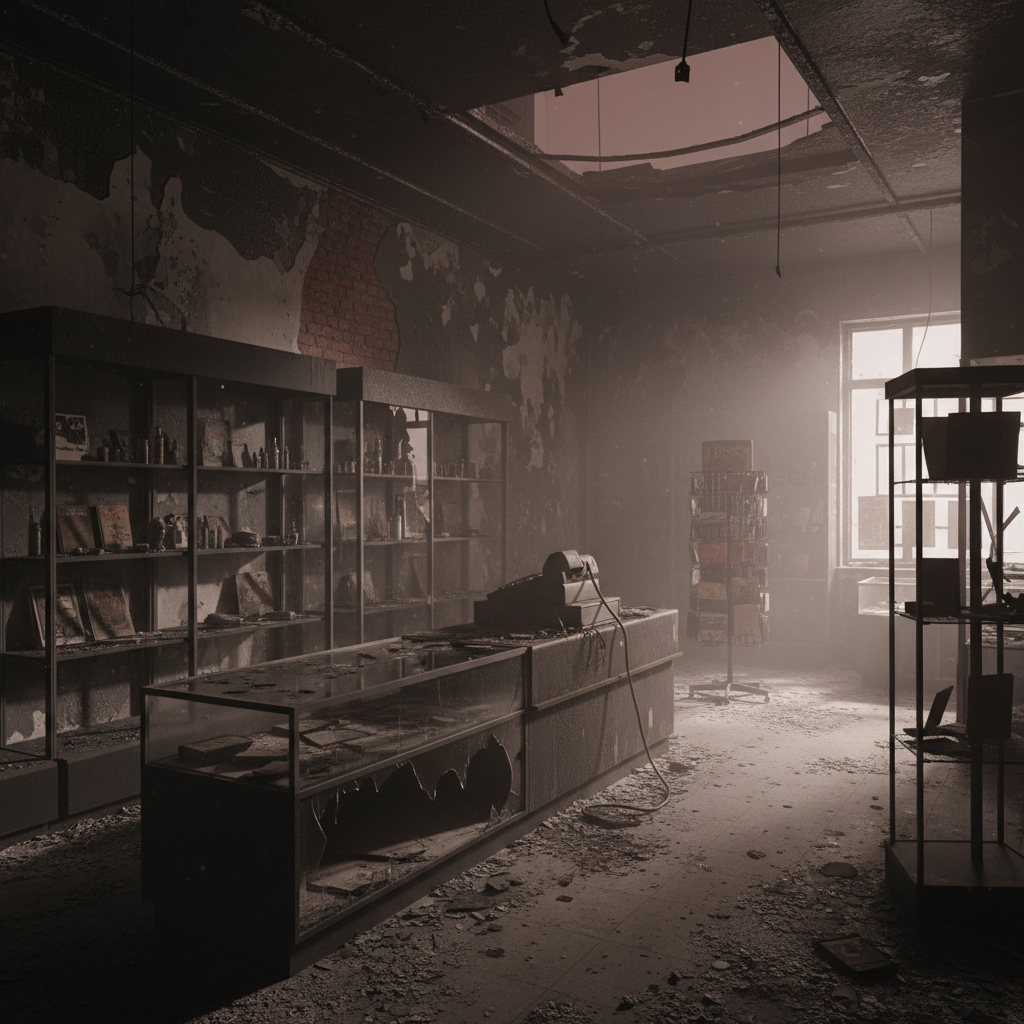
One of LA’s most eccentric cultural institutions, the Museum of Jurassic Technology (MJT), suffered significant fire damage earlier this month. The fire destroyed the MJT’s gift shop and caused smoke damage across several exhibits. The museum, which closed immediately following the fire, is expected to have lost revenue of up to $75,000 during its closure, and hopes to reopen next month.
MJT’s troubled financial status is a new wrinkle on what has otherwise been a long, quixotic career on the city’s museum scene. Since its opening in Culver City in 1988 by David Hildebrand Wilson and Diana Drake Wilson, the MJT has charmed, confounded, and occasionally angered visitors to its old warehouse home on 59 North Venice Boulevard. Ostensibly dedicated to the advancement of knowledge and the public appreciation of the Lower Jurassic, the MJT in reality has little to do with the era after which it is named. The MJT’s inspirations can be found much further back in history than the Early Jurassic period: It’s a direct descendant of wunderkammers, cabinets of curiosity created during the Renaissance period as the forerunners to the modern museum.
The MJT has been a go-to for self-effacing, multilayered narrative-building since it opened its doors. Some of the museum’s pieces are verifiably authentic pieces of history, from antique coins and scientific oddities to the rescued dioramas of eccentric millionaire Lionel Wilson (no relation to MJT’s co-founder David Wilson). Others are so ambiguous in their presentation of fact and fiction that visitors are often unsure of what they’re looking at. One of the MJT’s permanent exhibits features the life and work of Athanasius Kircher, a real 17th-century Renaissance polymath and Jesuit priest with obsessive tendencies. Another display is dedicated to Armenian-American artist Hagop Sandaldjian, a creator of ultra-miniature sculptures so small they can only be displayed on the inside of the eye of a needle. They are made of single strands of human hair.
Other exhibits are even stranger. One display is a collection of decaying dice belonging to magician Ricky Jay; another, The Garden of Eden on Wheels, is a visual essay on L.A.-area trailer parks. The museum has housed stereographic radiographs of flowers, microscopic mosaics made of butterfly wing scales, and an exhibit of “obscene, venomous, heartbreaking, beautiful letters” written by amateur astronomers to the Mount Wilson Observatory from 1915 to 1935. The MJT has also operated a Russian tea room since 2005; in an emulation of the study of Tsar Nicholas II in St. Petersburg’s Winter Palace, it was staffed by “authentic” tea servers for a time.
Firefight and Aftermath
The specifics of the fire were detailed in a long-form essay by writer Lawrence Weschler, whose own 1996 book Mr. Wilson’s Cabinet of Wonder explores the authenticity of many of MJT’s exhibits and, in some cases, even helped to confirm the factuality of the pieces’ origin stories. The fire was first noticed by David Wilson, who lives in a residence adjacent to the museum. He looked outside and spotted flames on the museum building. He left his apartment with two fire extinguishers, but when he reached the front door of the museum, the fire was bigger than he thought. “There was a ferocious column of flame, roaring and licking its way up the corner wall that faces the street,” Wilson later wrote.
Wilson ran to the street, where he was able to use the extinguishers to create a firebreak. But they were inadequate for the task, and Wilson realized he would not be able to hold it off for long. He then noticed his daughter and son-in-law pulling up in their car. His son-in-law quickly located a large extinguisher in the back of their car and managed to contain the fire before firefighters from the Culver City Fire Department arrived on the scene. If they had arrived one minute later, Wilson was later told, the entire building would have burned.
While the damage was mostly limited to the gift shop area, smoke from the blaze spread through the museum. “It was as though a thin creamy brown liquid had been evenly poured over all the surfaces—the walls, the vitrines, the ceiling, the carpets and eyepieces, everything,” Wilson later recalled. Smoke damage is a particularly thorny problem, and particularly so in the case of the MJT, which prides itself on the presentational quality of its displays. Since the fire, museum staff and volunteers have been working to clean the smoke damage and repair the building where it was affected. This is a labor-intensive process that Wilson wrote would move “glacially.”
In the meantime, Weschler has called for donations to the museum’s general fund to assist with the financial impact of the fire and closure. He stressed the importance of the MJT, which he called “one of the most truly sublime institutions in the country” and a place that “simply can’t be written off, can’t be dismissed” because it “operates so resolutely and so provocatively, so deliciously, at the crossroads of science, art, fraud, narrative, and ventriloquism.”
MJT’s estimated reopening is sometime next month. In the meantime, we wait, with bated breath, for it to unlock its door again and reemerge, ghoulish and gorgeous as ever.