
- calendar_today August 6, 2025
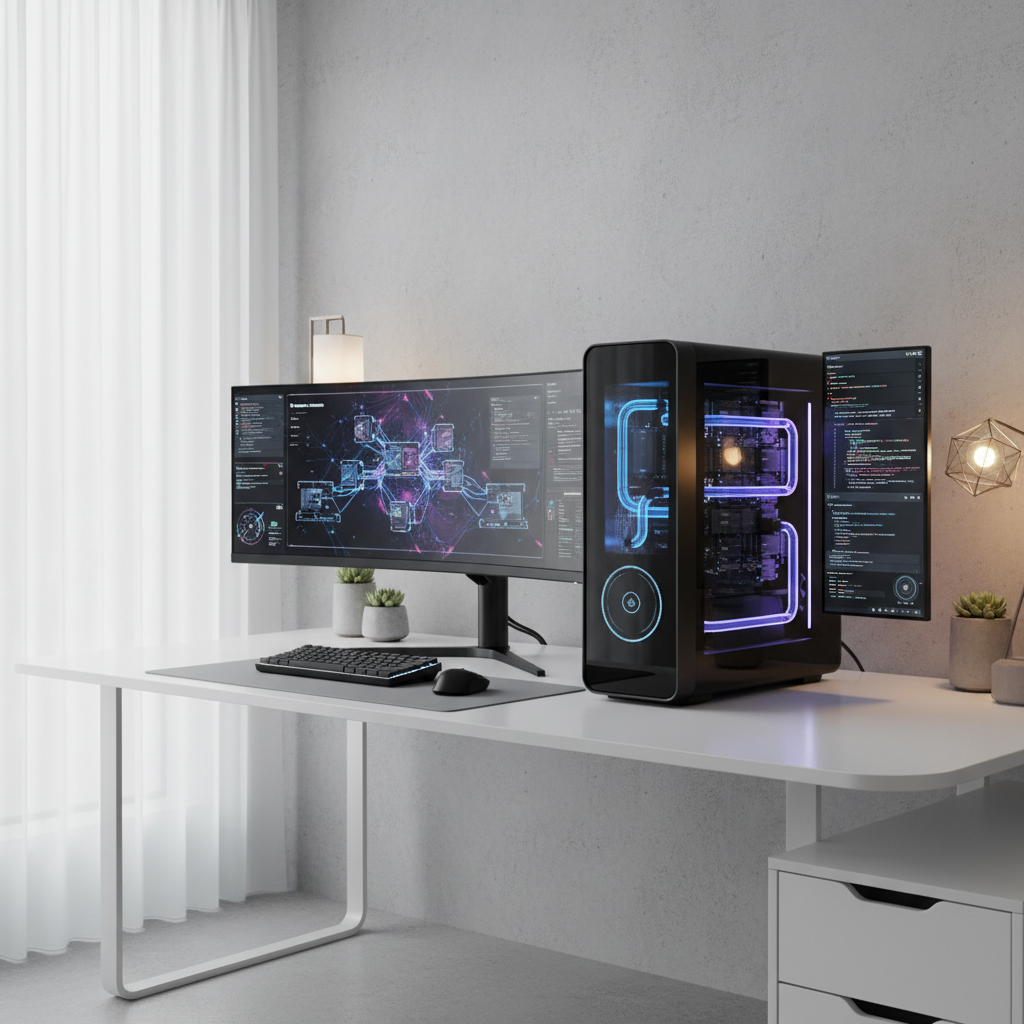
Nvidia has transformed desktop computing through its DGX Spark and DGX Station personal AI supercomputers which deliver unparalleled AI abilities to developers, researchers, and data scientists. CEO Jensen Huang introduced these systems at Tuesday’s Nvidia GTX keynote as groundbreaking tools that shift the paradigm by allowing developers to locally prototype, fine-tune, and execute large AI models with exceptional efficiency.
The Grace Blackwell Platform: Powering AI Innovation
The DGX systems function around the innovative Grace Blackwell platform which provides specialized architecture to handle modern neural networks’ high computational requirements. This architecture moves beyond conventional PC designs to establish a new category of machines that operate most efficiently with AI-native applications. AI has created transformative changes across all components of the computing stack according to Huang. AI-native developers and applications require different computing needs which makes the emergence of a new class of computers logical.
DGX Spark: Compact Power for AI Development
The cutting-edge GB10 Grace Blackwell Superchip powers the DGX Spark with an advanced Blackwell GPU that contains fifth-generation Tensor Cores. The combination of technologies delivers remarkable speeds with up to 1,000 trillion operations per second when processing AI workloads. This remarkable processing capability allows users to carry out advanced AI tasks at speeds never seen before which opens up new opportunities in machine learning data analysis and complex simulations. The DGX Spark becomes the perfect tool for severe AI challenges because it integrates advanced technologies which deliver superior efficiency.
DGX Station: Ultimate Performance for Advanced AI
The DGX Station delivers top-tier performance with its GB300 Grace Blackwell Ultra Desktop Superchip which provides 784GB of coherent memory and the ConnectX-8 SuperNIC for networking speeds up to 800Gb/s. The system setup delivers peak performance for highly demanding AI applications.
Bridge System Functionality: Seamless AI Workflow
Dubbed “Project DIGITS” before its current name these DGX systems transcend traditional desktop capabilities by operating as independent AI labs which enable AI models to move from local development to DGX Cloud or any AI cloud infrastructure with minimal code changes. The “bridge system” functionality optimizes AI development workflow through improved flexibility and efficiency.
Collaborative Manufacturing: Expanding Accessibility
The DGX architecture functions as a guiding template for major PC manufacturers to develop their personalized versions. Major PC manufacturers Asus, Dell, HP, and Lenovo have pledged to create and market DGX systems. The production of DGX Station will include contributions from BOXX as well as Lambda and Supermicro. Multiple stakeholders participating together enables wider access and versatile setups to meet different user requirements.
Pricing and Availability: Democratizing AI Supercomputing
Nvidia has withheld specific price information because multiple manufacturers are involved but mentioned that a DGX Spark-like computer with basic configuration costs about $3,000. The DGX systems combine competitive pricing with superior performance to appeal to AI developers who want to expand their research limits.
Customers can make reservations for DGX Spark right now which indicates its immediate availability as an effective tool. The DGX Station which provides superior performance capabilities will be released later in 2025. The DGX desktop series from Nvidia extends beyond launching computers as it provides widespread AI supercomputing access which enables emerging innovators to influence artificial intelligence development.