- calendar_today September 2, 2025
Apple has discovered a new way to avoid the consequences of Donald Trump’s trade war: by flattering the president.
On Wednesday, Trump announced that Apple would be spared from an impending 100 percent tariff on semiconductors, a move that would have raised the prices of iPhones in global markets. Reuters reports that Trump’s decision to spare the company came after Apple promised to invest another $100 billion in U.S. facilities on Wednesday, and also gifted Trump with a special, personalized statue.
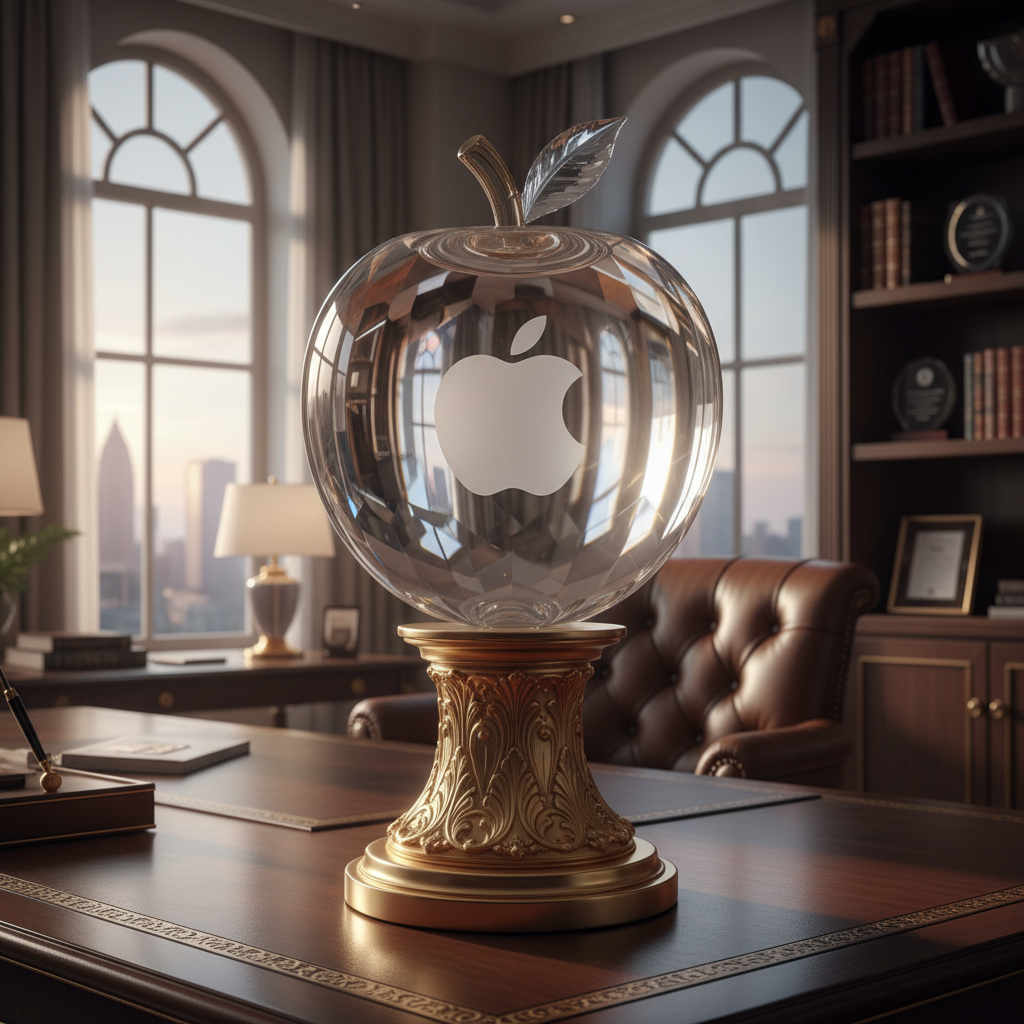
Apple CEO Tim Cook described the statue to Trump as “made in America,” and said it was created by Corning, an Apple supplier known for specialty glass used in iPhones. The item was a large glass circle cut with a simple, bold Apple logo in the middle. The piece, Cook noted, came from Utah. Trump’s name was engraved on a 24-karat gold base that had been affixed to the bottom of the statue. Cook added his own personal flourish, penning a signed note: “Made in America.”
Trump, who has spent months browbeating companies to make more products at home, seems to have liked the symbolism. At the unveiling in the Oval Office, Trump doubled down on Apple’s good fortune. The president noted that Apple, and any company that builds manufacturing facilities in the U.S., would face “no charge” from tariffs on semiconductors when they go into effect. The announcement is a huge victory for Apple, which has been subject to months of Trump’s public pressure over the location of its supply chain.
Trump’s latest pronouncement comes after a turbulent spring. In the past few months, Trump has berated Apple for relocating parts of its iPhone supply chain to India, rather than bringing them to the U.S. In April, Trump promised that his trade war would mean that “next year, you’re going to have ‘Made in America’ iPhones.” In May, his tone turned testier: At a press conference in the Middle East, Trump said he had “a little problem with Tim Cook,” then reportedly called the Apple CEO directly to elaborate. “We are treating you really good, we put up with all the plants you built in China for years,” Trump reportedly told Cook. “We are not interested in you building in India.”
Analysts have long pointed out that moving iPhone assembly to the U.S. is an arduous task, if even possible at all, and would take years to complete. But Trump’s team pushed the idea that the transition was possible. Commerce Secretary Howard Lutnick went so far as to suggest that Apple was looking into “robotic arms” to recreate the precision of Chinese factories in the U.S.
Cook’s Oval Office Visit Follows Long Campaign of Charm
Cook’s appearance and Wednesday’s announcements are the latest in a long campaign by Apple to charm the president. Trump has consistently responded with a wink and a nod, accepting Apple’s investments but rarely following through on his more aggressive demands.
In 2017, Trump began touting plans for Apple to build three “big, beautiful” plants in the U.S. One was eventually constructed, and it produced face masks, not electronics. In 2019, Trump visited a Texas plant he claimed could be used to produce iPhones. The plant was instead dedicated to producing MacBook Pros, and Trump was left short of his goal of “Made in America” iPhones.
Apple on Wednesday said it would spend a total of $600 billion in the U.S. over the next four years. The figure is eye-popping, but analysts told Reuters that it is in line with Apple’s spending patterns and repeated pledges from the Biden administration and Trump’s previous term. In other words, Apple might not actually be offering the U.S. much of anything beyond what it was already going to.
Trump has threatened that he will penalize companies that don’t live up to pledges like this one with retroactive tariffs. But as Apple stands now, it appears to be doing business as usual: continuing its existing investment plans, while maintaining iPhone production overseas. The calculation on tariffs has not changed, but Trump has so far decided not to enforce the issue, at least until next year.
Wall Street analysts view Apple’s performance as shrewd. Nancy Tengler, CEO and CIO of Laffer Tengler Investments, which owns shares in Apple, told Reuters that the company’s moves were “a savvy solution to the president’s demand that Apple manufacture all iPhones in the U.S.”
Cook, for his part, has successfully bought Apple more time in the trade war, using a tried-and-true playbook of charm, optics, and calibrated investments. Trump has repeatedly used this optics to frame progress toward his goals of “Made in America,” but so far, Apple has found no reason to move its most complex manufacturing operations out of China and into the U.S.—and has managed to do so without paying the price of tariffs.