- calendar_today August 7, 2025
.
Ukrainian President Volodymyr Zelenskyy said on Monday that he had a “good” conversation with U.S. President Donald Trump on the issue of security guarantees for Ukraine, as the war with Russia enters its fourth year.
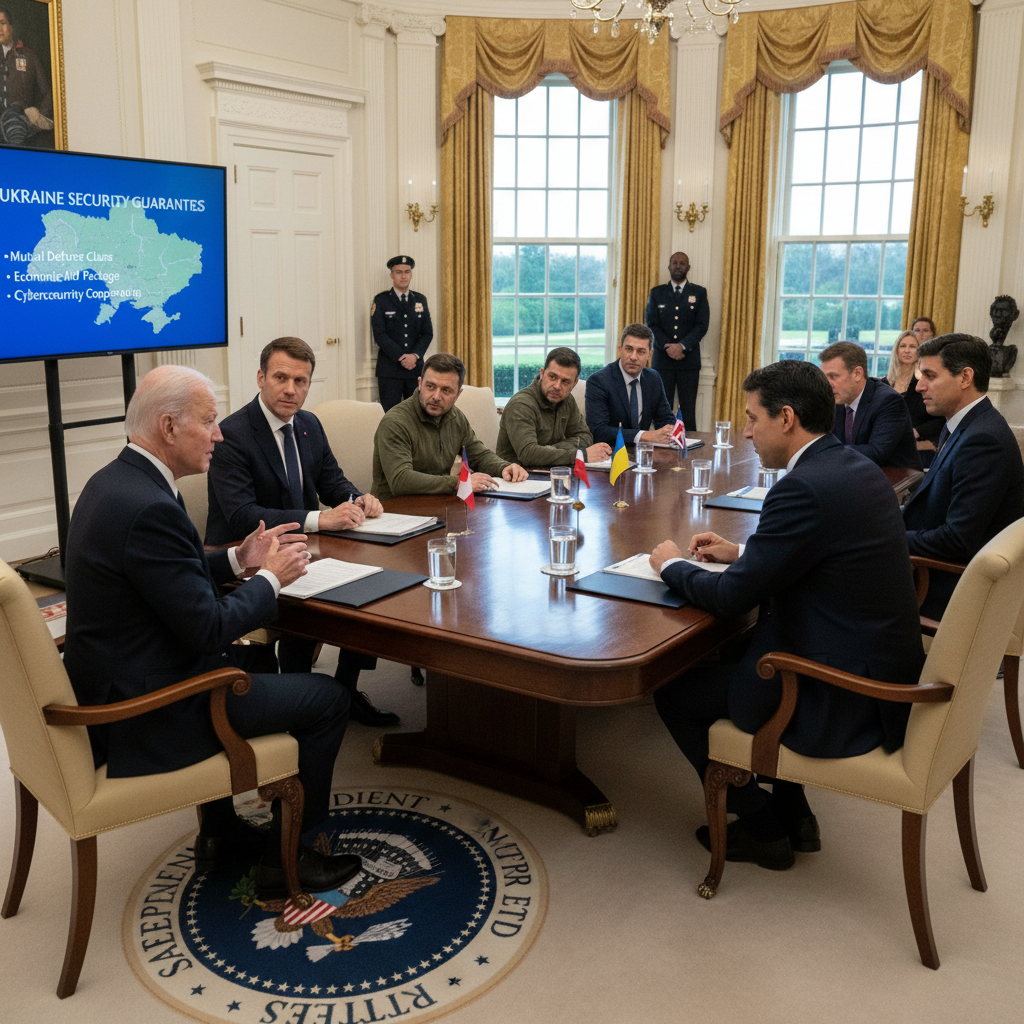
Speaking at the White House alongside Trump and European leaders, Zelenskyy said that security guarantees remain at the core of Ukraine’s survival and future independence. “The first one is security guarantees. And we are very happy with President [Trump], that all the leaders are here, and security in Ukraine depends on the United States and European countries,” Zelenskyy said. He also said that Washington’s readiness to extend strong signals of support to Kyiv was “very important,” but declined to outline what specific guarantees would look like.
Trump agreed with the security guarantees, but noted that Europe would have to bear most of the burden. He also argued that the conflict cannot be resolved without difficult talks about territory. “We’re going to help them, and we’re going to make it very secure,” Trump said. “We also need to discuss the possible exchanges of territory, taking into consideration the current line of contact. That means the war zone, the war line center.”
The White House meeting highlighted sharp differences between Western leaders on how to balance support for Ukraine with the pursuit of a negotiated peace. Trump had said he is open to territorial concessions, while Zelenskyy repeatedly stated that Ukraine’s sovereignty and internationally recognized borders must be maintained.
Sanctions, Ceasefire Debate, and the NATO Question
While Washington’s leaders were discussing guarantees, U.S. lawmakers were sharpening their calls for economic pressure on Moscow and its trading partners. Senator Lindsey Graham, R-S.C., said the Trump administration should move more aggressively against Moscow’s finances by sanctioning countries still buying Russian oil. He is cosponsoring a bill that would allow Trump to impose tariffs of as much as 500 percent on the sale of goods from countries that continue doing business with Russia.
“My advice to President Trump and [Secretary of State Marco Rubio] is, you’ve got to convince Putin that if this war doesn’t end justly and honorably with Ukraine making concessions also, we’re going to destroy the Russian economy,” Graham said on Fox News. “The second most important person on the planet to end this war is President Xi in China,” Graham said, “You’ve got to pressure China not to allow Putin to continue his aggression.”
Trump has already shown a willingness to use tariffs to that end, imposing in August a 50 percent tariff on India partly in response to New Delhi’s purchase of Russian oil. Graham suggested that a similar threat against China would have a catalyzing effect on the conflict.
Across the Atlantic, the European Union is getting ready for its 19th round of sanctions against Russia. New measures due later this month will further clamp down on Moscow’s energy revenues, banking access, and military-industrial base. EU diplomats are also working to close loopholes in existing sanctions that allow for evasion, which have given Moscow economic lifelines. Coordinated Western action over the past four years has made Russia the most sanctioned nation in modern history, more economically isolated than Iran, North Korea, or Venezuela.
Still, sanctions are not the only sticking point. European leaders have also urged Trump to demand a ceasefire before any serious negotiations can start. German Chancellor Friedrich Merz said that a temporary halt to the fighting is needed to give the peace talks credibility. “I can’t imagine that the next meeting would take place without a ceasefire,” Merz said. Trump rejected the notion, noting that several of the six peace agreements he claimed to have brokered in recent months were struck without a ceasefire in place. “You have a ceasefire, and they rebuild and rebuild and rebuild,” Trump said, while conceding that the main appeal of a truce would be the immediate cessation of civilian casualties.
Finnish President Alexander Stubb, who was sworn into office in March 2024, also joined White House talks. Stubb has been openly skeptical of Russian President Vladimir Putin’s willingness to respect any ceasefire and emphasized Finland’s own historical experience with its neighbor, including the country’s 800-mile border with Russia. Stubb, a key ally and one of Trump’s closest European interlocutors, said: “If I look at the silver lining of where we stand right now, we found a solution in 1944, and I’m sure that we’ll be able to find a solution in 2025 to end Russia’s war of aggression.”
Beyond sanctions and ceasefires, Trump has been more blunt still about his conditions for peace. In a post on Truth Social, he urged Ukraine to formally relinquish Crimea, which Russia annexed in 2014, and to give up on its stated goals of joining NATO. “President Zelenskyy of Ukraine can end the war with Russia almost immediately, if he wants to, or he can continue to fight,” Trump wrote. He blamed the Obama administration for “giving” Crimea to Russia without a fight more than a decade ago and repeated his demands that “NO GOING INTO NATO BY UKRAINE” must be a red line for Ukraine.
The stark contrast between Zelenskyy’s calls for long-term Western guarantees and Trump’s demands for Ukrainian concessions highlighted the deep divides in Washington and Europe over how to end the war. With new sanctions on the horizon, rising tariff threats, and continued battlefield clashes, the path to peace is uncertain—caught between demands for compromise and calls for solidarity.