
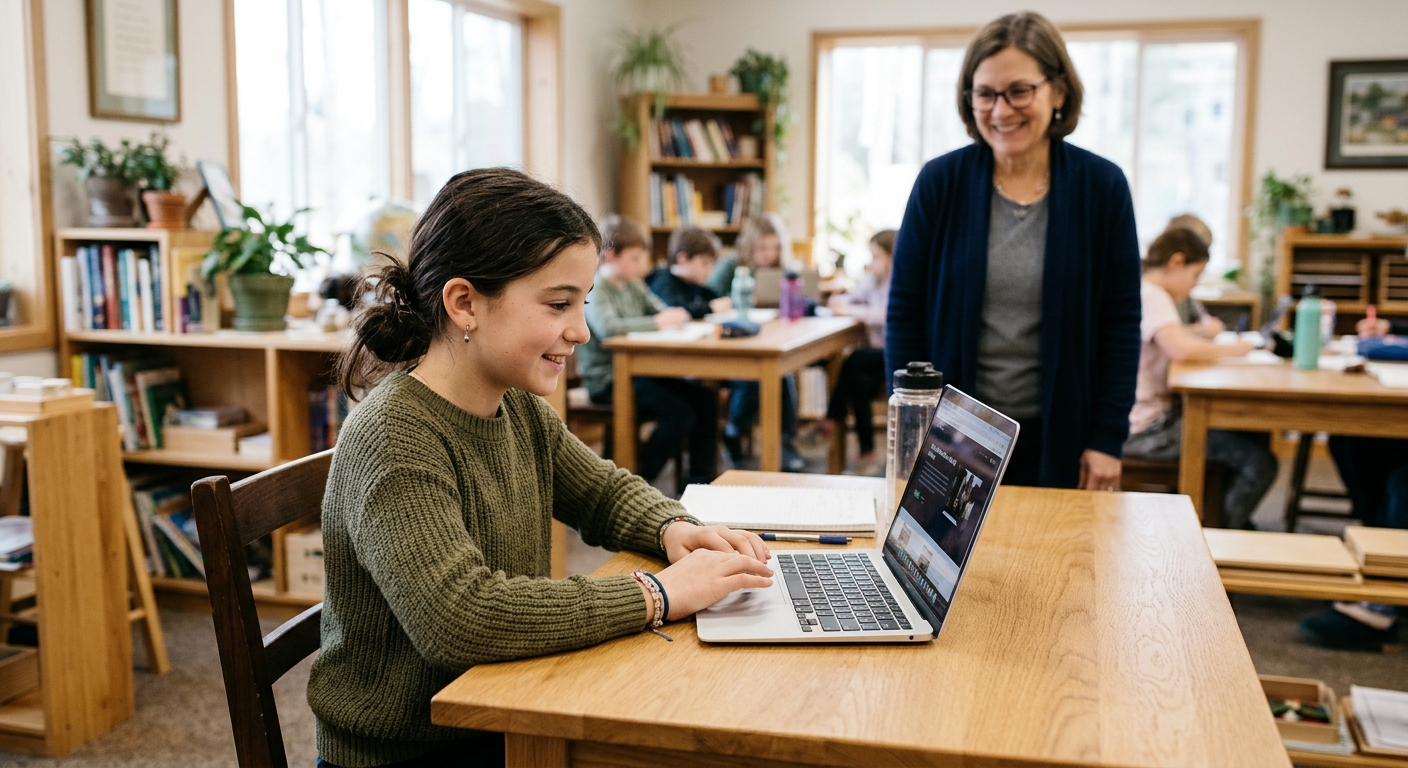
AI-generated illustration; not a photograph of the reported event.
- calendar_today October 22, 2026
AI at the Center of Alpha School’s Unique Model
At Alpha School, students like eighth grader Zane Shah experience a radically different classroom. Each morning, Shah and his classmates arrive not to meet traditional teachers, but to interact with “guides” while artificial intelligence handles their academic instruction. The Alpha School network, a for-profit group of private institutions, recently opened its first Chicago campus for pre-K through eighth grade, further spreading its unconventional approach to education technology.
How Alpha’s Teacherless Model Works
Academic learning at Alpha School is compressed into just two hours each day. Students work independently on laptops using adaptive learning software. The system, called TimeBack, was developed by cognitive scientist Carl Hendrick’s team at the Netherlands' Academica University of Applied Sciences. TimeBack software adapts to a student’s skills—reviewing earlier material if learning gaps are found—and is used both on Alpha campuses and at a handful of partner private schools. Alpha students tackle core subjects—math, reading, writing, language, and science—through this platform. According to the school, this accelerated schedule is sufficient to meet, and even exceed, standards achieved in traditional eight-hour school days.
Human Support: Guides and Coaching, Not Traditional Teaching
The adults on Alpha’s campuses are called guides, and most of them do not have backgrounds in education. According to a University of Colorado National Education Policy Center analysis, only about one-third of Alpha’s guides have education degrees or formal teaching credentials. Lead guide Carrington Haas says that instead of providing direct academic instruction, staff at Alpha focus on motivational and emotional support. Academic coaching is provided as needed remotely by a learning science team made up of licensed teachers and subject-matter experts. Students can connect with curriculum specialists via coaching calls if the adaptive software alone is insufficient to solve a problem.
Dean of parents Brian Howell explains that guides do not supply academic answers directly but guide students to revisit and reflect on problems, using hints generated by the software. The mastery-based learning model at Alpha requires students to demonstrate understanding before advancing.
Costs and Claims of Academic Excellence
Attendance at Alpha Chicago comes with a high price tag: $55,000 per year, about $8,000 more than the average annual cost of a private college, according to U.S. News & World Report. The school claims its students consistently score in the top 1% on national standardized tests. Rather than select applicants by grades or test results, Alpha seeks students who are “coachable” and self-motivated.
The school insists behavioral issues, not academic shortcomings, are the prevailing reasons for student dismissal. Brian Howell reports that Alpha graduates have been accepted into top universities, including Stanford, Northwestern, and Rice.
Parents, such as Zane Shah’s father Binoy, see increased student engagement. He notes that Shah is now more communicative and excited about his education compared to previous years in traditional schools.
System Limits and Education Expert Skepticism
Alpha’s TimeBack software is deliberately isolated from the open internet and, according to staff, functions less like a chatbot and more like a private tutor. The system does not provide answers directly and relies on rigorous data tracking by education experts to monitor student progress. Still, critics question whether this approach delivers on its promises.
Rebecca Winthrop, a senior fellow with the Brookings Institution, cautions families that Alpha’s model is experimental and lacks clear, externally validated evidence of its outcomes. She emphasizes the importance of deep reflection in learning—something she feels the model may not adequately support.
Others, like Carol Corbett Burris from the Network for Public Education, view Alpha School as an experiment in “extracting maximum profit from schooling” instead of expanding opportunity. Burris cites the performance of Unbound Academy, a free charter school using Alpha’s TimeBack platform, arguing that it fell short compared to other Arizona public schools, despite earlier promises.
The Future of AI-Based Education?
Alpha School’s mastery-based, AI-driven approach has provoked both enthusiasm and skepticism in the broader debate over artificial intelligence education. While some families find value in its student coaching and unique learning structure, questions remain among education experts about its long-term outcomes and the efficacy of replacing teachers with technology and guides.
Source: cbsnews.com.