
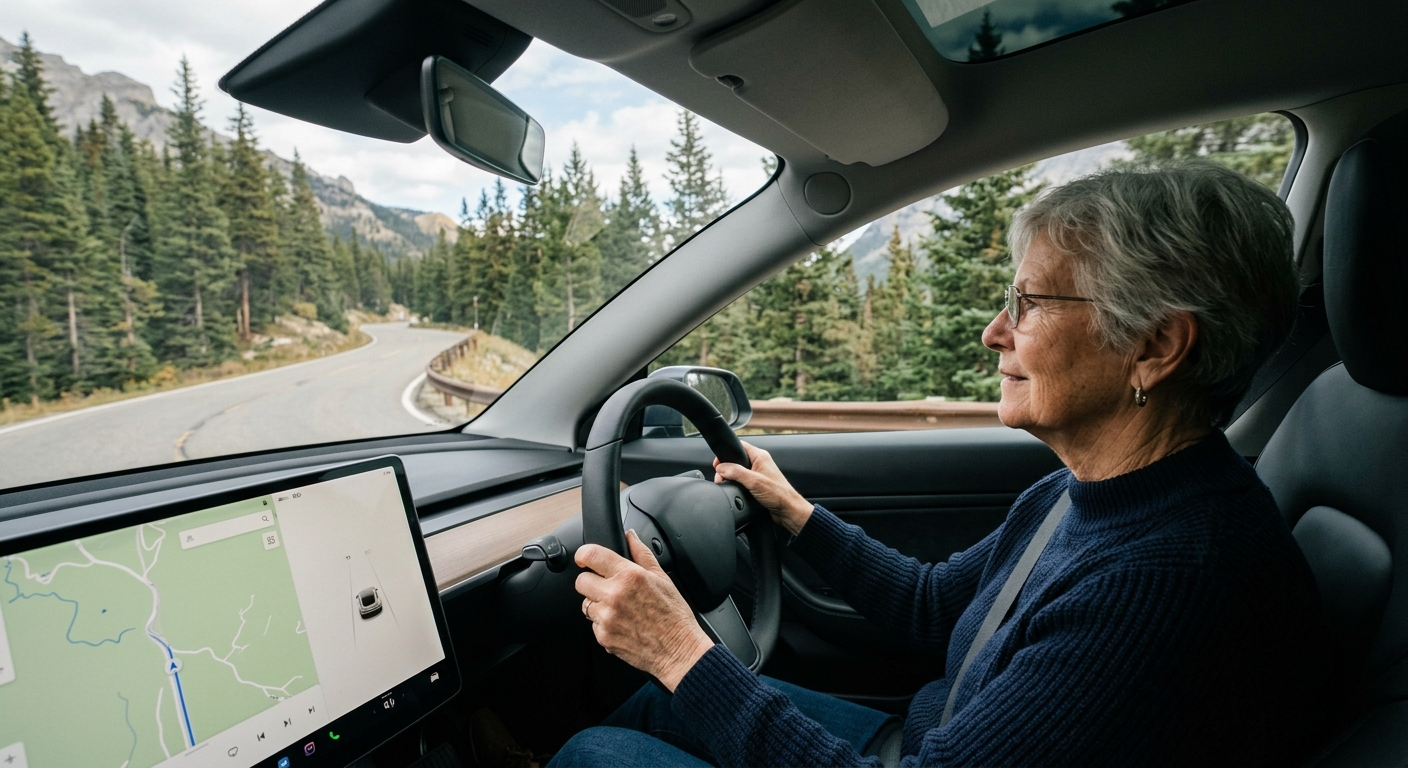
AI-generated illustration; not a photograph of the reported event.
- calendar_today November 23, 2026
Older Americans Embrace Automated Driving for Independence
In Evergreen, Colorado, Joan Spalding, 89, has found a new way to maintain her independence behind the wheel. After decades of navigating steep, winding roads near her home outside Denver, she now relies on her Tesla Model Y's Full-Self Driving (Supervised) feature—commonly known as FSD—for most trips. Telling the car her destination and pressing a dashboard button, she watches as the vehicle confidently drives itself along narrow dirt tracks and mountainous terrain, intervening only when necessary.
From Skepticism to Confidence with Tesla FSD
Initially, Spalding was hesitant to try Tesla's advanced driver assistance. However, after experiencing FSD's capabilities firsthand, her confidence grew: "When I was driving, I saw that the kind of things that it did were safer than what I would do," she said. Spalding's Model Y is equipped with Tesla's subscription-based FSD (Supervised) service, which costs drivers around $99 per month.
Seniors and the Appeal of Driver Assistance Technology
With a growing population of older drivers in the U.S., families often face the challenge of determining when it's time for a loved one to give up their keys. Automated driving technology offers many a chance to extend their independence for longer. Spalding, for instance, had previously experienced several minor accidents and a major crash two years ago, which prompted her son Mike to encourage her to try a Tesla. Both appreciated the additional safety features and technology, with Mike noting, "It's better than me." Tesla itself claims that FSD is up to nine times safer than human driving, although these claims have not been independently verified.
Expert Warnings on Limitations and Risks
Despite its appeal, safety experts urge caution. Bryan Reimer, a research scientist at MIT, raises concerns about Tesla overselling its technology: "It's not a technology that I would drive with. It's not a technology that I would suggest that my loved ones use. I think it has a few safety gaps that just make me uncomfortable." He and others, like Alexandra Mueller of the Insurance Institute for Highway Safety, highlight that FSD requires constant driver supervision—the technology is not fully autonomous, even if the name suggests otherwise. Experts worry that older drivers may become complacent or lack the ability to take control in emergencies, especially if age-related impairments are present.
Growth in Adoption and Public Endorsement
While Tesla does not publish demographic details about its FSD subscribers, the company reports more than 1.7 million active subscriptions—an increase of 67% over the past year. CEO Elon Musk has actively promoted the technology's benefits for senior drivers, stating on his social platform X that "Tesla self-driving gives mobility to seniors." Musk has also shared stories from elderly Tesla owners, including a widely viewed video of 98-year-old Larry Dimmock, who praised his car's performance and recounted how the system avoided running over a chipmunk.
Independence and Quality of Life for Older Drivers
For seniors like Spalding and Dimmock, Tesla's automated driving system means more than convenience—it allows them to maintain their independence and stay in their homes longer. Spalding believes that without the mobility provided by FSD, she would likely need to move elsewhere. "This way, I think I can drive it for as long as I want to. I don't see any reason why not," she said.
Conclusion
The use of Tesla's Full-Self Driving (Supervised) technology by seniors highlights both the promise and the challenges of automated driving. While many older drivers find renewed independence and safety, experts continue to stress the need for vigilance and realistic expectations from these advanced, but still imperfect, driver assistance systems.
Source: npr.org.